August 6, 2026
The Role of Landing Pages in Assisted Living Marketing

How do senior living communities increase occupancy? Not with more leads. Rather with better conversations.
The most common reason senior living occupancy stagnates is not a marketing problem. It's a discovery problem.
During discovery teams talk about square footage and activity calendars while families are quietly asking themselves, "Will my mom be safe here? Will she still be herself?"
The communities that grow census consistently do three things differently. They train their sales teams to uncover what families actually need. They build referral relationships that don't depend on placement agencies. And they coach continuously, not once a year at a conference.
I spent years speaking with customers in hospitality sales and as VP of Sales & Marketing for three CCRCs, managing marketing and sales generating more than $52 million in annual revenue. I hit 92% presales two years before one community opened its doors. I've sat across the table from hundreds of families making one of the hardest decisions of their lives.
This guide is everything I learned about census growth in those rooms. Not theory. What actually fills communities and keeps them full.
Operators are busy, so here's the short version. The full argument, the data, and the how-to follow.
Census growth is a trust, discovery, and coaching problem, not a lead-volume problem.
The fundamentals of occupancy growth haven't changed. Families still choose communities they trust. But the environment around that decision has shifted in ways that expose a weak census strategy.
Start with what the data says, because it sharpens the question. According to the National Investment Center for Seniors Housing & Care (NIC), senior housing occupancy climbed to 89.5% in the first quarter of 2026, the 19th consecutive quarter of gains, with independent living above 91% and assisted living at 87.9%. Meanwhile, units under construction fell to their lowest level since 2012, and annual inventory growth hit a record low of 0.4%. NIC analysts expect the sector to pass 90% occupancy before the end of the year.¹
Those numbers change the question. As NIC's head of research and analytics, Lisa McCracken, put it, "the bottleneck is largely on the capital side, not from lack of demand." Demand is not the problem. Demand is at historic strength.
So, if occupancy is climbing nationally and your census is flat, the market isn't the explanation. In the strongest demand environment in over a decade, an empty apartment is rarely an inquiry problem. It's a conversion problem. A rising market doesn't lift every community. It sorts them.
And if your community is already full? The same skills don't stop mattering. In a tight market, conversion quality becomes rate integrity, waitlist depth, and better resident fit. Full communities still lose census through move-outs that trace back to an admission that was never right for the resident.
And the sorting happens through four shifts in how families decide:
Decision cycles are longer. Families research for months before they ever call you. By the time they tour, they've compared pricing, read every review, and asked an AI tool which communities to consider.
Family anxiety is higher. Staffing headlines, cost concerns, and care-quality fears mean families arrive skeptical. A scripted tour confirms their skepticism. A real conversation disarms it.
AI has changed how families research. As covered in how AI search is reshaping occupancy growth, families now ask ChatGPT and Google AI questions like "Which assisted living communities near me have the best reputation?" If your community isn't part of those answers, you're invisible during the most important phase of the decision.
Placement competition keeps growing. More operators are outsourcing their pipeline to placement agencies and paying for it twice. Once in fees, and again in lost control over their own reputation and relationships.
Here's what I tell every operator I work with: the communities that increase census most successfully aren't outspending anyone. They're out-converting everyone.
When occupancy stalls, it's rarely an effort problem. Most often, sales is being measured by lead volume when census actually grows through conversation quality.
When discovery conversations are underdeveloped, it's easy to mistake a lead shortage for the real issue. The leads were there. The conversations lost them.
There's a second reason teams struggle, and it's newer. The decision now forms upstream, before your team knows the family exists. A daughter reads your reviews at midnight. She visits your website a dozen times without filling out a form, compares you to two other communities, and asks an AI tool which options near her are best. All of it happens in the in-between moments of her week, in places no CRM records.
By the time a family calls you, the decision has been forming for weeks. The inquiry is not the beginning. It is the first visible sign.
What this means for your team: when a family finally sits across from you, they are not at the start of their emotional journey. They are somewhere in the middle of it. The conversation doesn't create the decision, it determines whether they feel confident enough to act on it. The full upstream argument lives in the Need Behind the Need™ article, and it's why the visibility systems later in this guide are census systems, not marketing extras.
I've watched this pattern repeat at every level of the industry:
When I was carrying census responsibility inside CCRCs, the hardest lesson was this: the problem was almost never the leads. It was what happened after the phone rang.
After training sales teams across three CCRCs and coaching operators nationwide, I've seen four skills separate the communities that grow from those that struggle. None of them are complicated. All of them require practice.
Most tours start with the question, "What are you looking for?" The most effective salespeople ask a different one: "What's changed recently that made you start looking?"
The first question gets you a feature list. The second gets you the real story, the fall, the missed medications, the daughter who can't keep driving over three times a day. That story is where the move-in decision actually lives. Where connections are made, where understanding is formed.
Families rarely lead with their real concern. A prospective resident says, "Life hasn't been the same since my husband passed." It's easy to assume she wants socialization. Maybe she misses cooking for someone. Maybe she's afraid at night. You don't know until you ask.
This is the heart of my Need Behind the Need™ approach: the stated need opens the conversation, but the unstated need decides the move-in.
If I have one appeal, it's this. Please stop giving the same tour to every family. An adult child seeking memory care for a parent with advanced dementia doesn't need a swimming pool tour. A fiercely independent senior considering assisted living doesn't want to hear about how much help she'll get, she wants to hear how much of her life she'll keep.
Families rarely remember the floor plan. They remember how the conversation made them feel.
Most follow-up is a status check: "Just circling back to see if you've made a decision." That's pressure dressed up as politeness.
Trust-based follow-up adds value every time. Send an article about managing a parent's resistance or information to a local dementia support group for families. Reference the specific concern they raised. Remember their dog's name.
Families choosing assisted living are motivated most of all by trust and reassurance. Follow-up is where trust compounds, or collapses.
Here's the uncomfortable math most operators avoid: more leads do not fix weak discovery conversations. They just produce more tours that do not reinforce a needs match.
Say your community converts 20% of tours into move-ins. Doubling your lead volume is expensive, slow, and dependent on outside spend. Improving tour conversion from 20% to 30% costs a fraction of that and it compounds with every future lead you generate.
When I was overseeing sales across three CCRCs, the communities that hit their occupancy targets were never the ones with the biggest ad budgets. (I worked for a non-profit, our communities did not have large budgets.) They were the ones where the sales team could hold an honest, skilled conversation with a frightened family.
Marketing gets families to the door. What happens at the door determines your census.
And what about price? Every operator hears "we can't afford it," and affordability is a real concern. But here's what years of census responsibility taught me, when a family says no over price, it's often because price was the only thing the conversation gave them to weigh. Communities that convert on trust don't have to convert on discounts. Discounting is often the receipt for poor discovery.
That's also why getting found through GEO and AI search and converting well are partners, not competitors. Visibility without conversion skill wastes money that could be put to better use. Conversion skill without visibility wastes talent and creates frustration. A complete census strategy needs both.
Families do not buy based on features. They buy based on emotional reassurance, trust, safety, identity preservation, and caregiver relief. The non-tangibles and what I call the "warm fuzzies." Those are the key considerations for families.
Every senior living sales conversation operates on these two levels:
Discovery driven selling means structuring the conversation to surface what families mean before presenting anything.
Questions that open the real conversation to the upstream journey to find care:
Then stop talking. The salesperson who listens 70% of the time will outperform the one who presents 90% of the time. Every time.
One objection I hear from stretched teams is "These conversations take a long time." Yes. Yes, they do. And trust me, I understand. I've led teams where one person carried sales, marketing, and move-in coordination at once. But proper discovery doesn't add time to the conversation. It reallocates it. The forty-five minutes you're already spending on a tour either goes to presenting features or to understanding the family. Same minutes. Very different census.
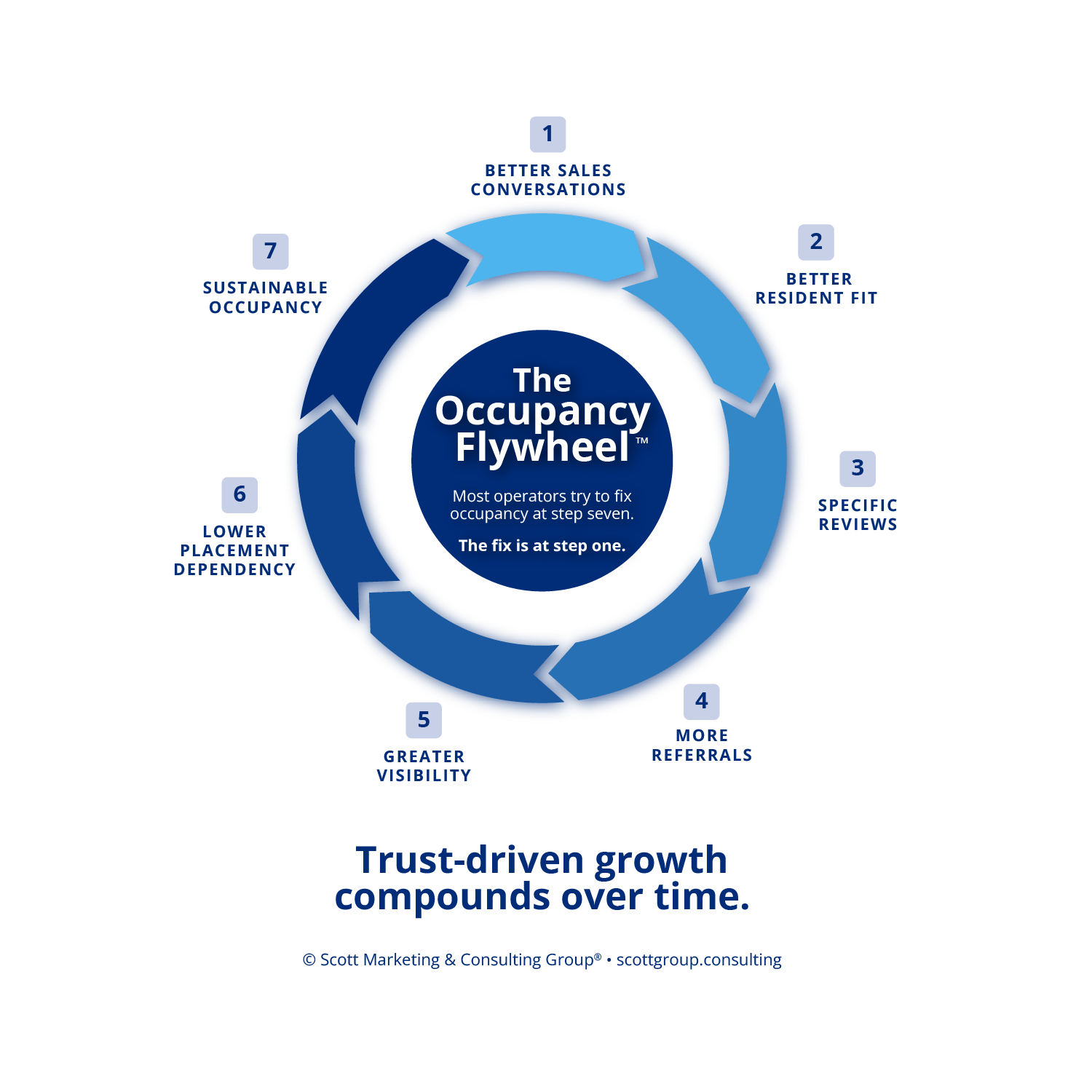
Census growth isn't a straight line from lead to move-in. It's a flywheel and discovery driven sales is what starts it spinning.
The Occupancy Flywheel™: better sales conversations → better resident fit → specific reviews → more referrals → greater visibility → lower placement dependency → sustainable occupancy.
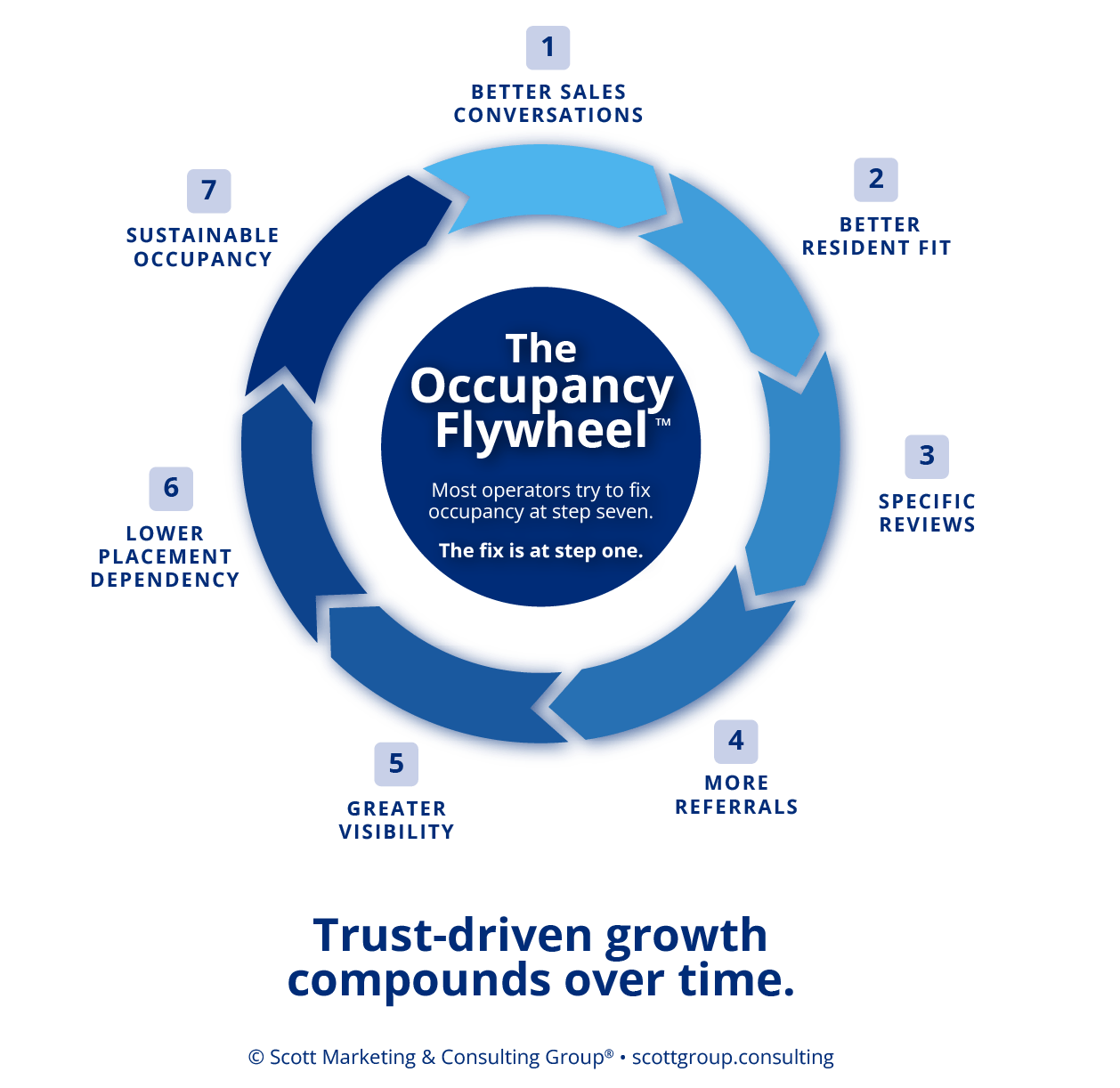
Here's how each turn of the wheel works:
Most operators try to fix occupancy at step seven, downstream. The fix is at step one, when the need first becomes visible to your community.
The fastest growing communities rarely improve every system at once. They identify the single weakest point in the flywheel and strengthen it first. Fixing one weak area often improves everything that follows.
Why are placement agencies risky long term? Because you're renting your pipeline instead of owning it, and reducing placement agency dependency is a system you can build.
A placement agency is a bridge. It's not a long-term occupancy strategy. Operators get in trouble when they rely on it.
Fees of one month's rent or more per move-in eat into your margin. Worse, the agency owns the family relationship until the day they walk in your door and they're showing that family your competitors too. I've written more about reducing placement agency dependency and what the transition looks like.
A healthy referral ecosystem replaces that dependency over time and has four pillars:
Physicians refer to communities they trust with their patients' outcomes.
That trust is built through:
One mishandled referral can quietly end years of relationship building.
Discharge planners work under brutal time pressure. The communities that earn their trust make their job easier:
I've seen communities lose discharge relationships not from poor care, but from slow responses.
Your happiest families are your most credible salespeople. But most communities never ask.
Build a simple, respectful process for inviting reviews and referrals at the moments when satisfaction is highest after a great care planning meeting, a successful transition or a family event.
Elder law attorneys, financial planners, home health agencies, faith communities. These referrals come pre-loaded with credibility.
That's the whole reason referrals outperform ads long term. An ad asks for trust. A referral arrives with it.
The goal isn't to eliminate every external lead source overnight. It's to shift the mix, year over year, toward relationships you own. Strong reputation management accelerates every one of these pillars.
Why is senior living sales coaching important?
Sales skills decay without reinforcement, and one-time training doesn't survive a stressful Tuesday.
The full case is in how sales coaching improves occupancy performance.
Coaching doesn't change your team in a week. It changes your census in a year.
I call this the Coaching Compound Effect. Consistent coaching improves one behavior at a time, and each improvement multiplies the others:
When I implemented structured coaching inside the communities I led, the change wasn't dramatic in week one. It was dramatic in month six and undeniable by year one. The biggest risk isn't that coaching won't work. It's stepping away before the compounding starts. Continual coaching helped us build a sales and marketing team I would confidently compare to organizations with far larger budgets.
This is exactly what our hospitality-based sales and marketing coaching is built to do for small and midsize providers.
Most census instability begins months before occupancy declines appear. The right KPIs are your early warning system.
Most communities track vanity metrics instead. Lead volume looks good in a board report and tells you almost nothing about census performance.
Track these six instead:
One number going up means little. The pattern across these six tells you whether your flywheel is turning and whether your census strategy is working or just busy.
After decades inside this industry, first carrying census responsibility myself, now coaching operators across the country, these are the mistakes I see most often:
None of these mistakes feel urgent on any given day. All of them show up in census performance within a year.
This is the section I'd urge every operator to read twice, because it's reshaping the front end of your sales funnel right now.
Families no longer start with a list of ten Google links. They ask AI tools conversational questions: "What should I look for in a memory care community?" "Which assisted living options near me have the best reputation for dementia care?" The AI system answers with recommendations, and if your community isn't represented, you've lost the family before your sales team ever had a chance.
What feeds those AI recommendations?
Here's the connection most operators miss: AI search rewards exactly what good sales culture produces. Authentic differentiation, specific reviews and real expertise made visible. The communities earning AI visibility and the communities earning tours are increasingly the same communities because both outcomes are built on trust you can prove.
At Scott Marketing and Consulting Group®, a senior living marketing agency serving small and midsize providers across the United States, this is where our work lives, in connecting GEO (Generative Engine Optimization) to the sales skills that support the families those strategies deliver.
The communities that increase census most successfully combine three things: discovery driven sales conversations, a diversified referral network they own, and ongoing coaching that keeps skills sharp. Lead volume alone doesn't grow occupancy, conversion quality does.
Four skills consistently move census: discovery questioning, active listening that uncovers unstated concerns, individualized tour presentation, and trust-based follow-up. Each one can be taught, but all four require ongoing coaching to become habit.
Sales skills decay without reinforcement, and one-time training rarely survives daily operational pressure. Ongoing coaching compounds improving tour conversions, follow-up discipline, and referral confidence simultaneously, which is why its ROI grows over time.
The KPIs worth tracking are tour-to-move-in ratio, inquiry-to-tour conversion, referral source diversity, response time and quality, family engagement depth, and review specificity. These measure census health far better than raw lead volume.
Referrals from physicians, discharge planners, and current families arrive with trust already transferred, so they convert at higher rates than paid leads. A diversified referral network also stabilizes occupancy and reduces dependence on placement fees.
Placement agencies charge substantial per-move-in fees and control the family relationship until move-in day while presenting your competitors alongside you. Used as a permanent strategy rather than a stopgap, they erode margin and prevent you from building referral relationships you own.
Families now ask AI tools like ChatGPT and Google AI which communities to consider, and AI systems recommend communities with specific reviews, authority content, and consistent trust signals. Communities invisible in AI answers lose families before the sales process ever begins.
If your team is working hard but your occupancy isn't moving, the problem usually isn't effort. It's the conversation and the system around it.
I've carried census responsibility inside three CCRCs and have supported the census development of over 50 communities in the U.S. and Canada. I know what the pressure feels like, and I know what actually relieves it. If you'd like an honest look at your sales process, referral mix, and AI visibility, let's talk.
Schedule a sales & census growth strategy call with us. No pitch, just a real conversation about what's possible for your community.
Prefer to start on your own? Download the Senior Living Census Growth Scorecard, a practical self-assessment covering your sales conversations, referral diversity, coaching culture, and KPIs.
Sources
[1] National Investment Center for Seniors Housing & Care (NIC MAP). "Senior Living Occupancy Grows Amid Construction Slowdown, Limiting Options for Older Adults" Q1 2026 data. https://www.nicmap.com/news/senior-living-occupancy-grows-amid-construction-slowdown-limiting-options-for-older-adults. Accessed June 2026.
Sandra Scott is the CEO and Founder of Scott Marketing and Consulting Group® (SMCG®), a senior living and healthcare marketing agency serving small and midsize providers across the United States and Canada.
A former VP of Sales & Marketing for three CCRCs, Sandra has led sales and marketing strategies, generating more than $52 million in annual revenue and achieved 92% presales two years before a community's opening.
Today, she specializes in senior living census growth strategies, sales coaching, GEO (Generative Engine Optimization), SEO, and occupancy focused marketing systems designed to help providers reduce placement dependency and strengthen long-term referral growth.
Sandra was named 2023 Innovator of the Year by the Residential Assisted Living Association, and SMCG® was recognized as a Top GEO Agency (2026) by First Page Sage.
Go Deeper on Each System in This Guide:
.jpg)